WWII in Prague hits hard. This small-group tour strings together the city’s wartime story with WWII artifacts and a haunting crypt visit tied to Operation Anthropoid.
I love the mix of walking plus included public transit, because it keeps the pace realistic while still getting you to places most people skip. I also like how the tour doesn’t just name dates—it shows you the physical spots where resistance and tragedy unfolded. One drawback to consider: it’s a packed, sometimes long stretch (some departures run closer to 3.5 hours), and there may not be much time for bathroom stops until later.
You’ll start at the Powder Tower, move through key WWII and resistance landmarks across Prague, and end at the National Monument to the Heroes of the Heydrich Terror near Resslova 9, after the most intense part under the cathedral. English-language guides lead the tour, and past groups have praised guides such as Hana and Pavel/Pawel for storytelling, photos, and answering questions.
In This Review
- Key things I’d watch for
- Why Operation Anthropoid matters in Prague
- Start at Powder Tower: getting your bearings (and your ears) right
- Czechoslovakia, secret flats, and the resistance trail through the streets
- Dům pánů z Kunštátu a Poděbrad: the 1944 air-raid shelter with artifacts
- St Cyril and St Methodius Cathedral: the parachutists’ final price
- The crypt and Operation Anthropoid museum: what the Heydrich Terror stop does to you
- Timing, walking, and hearing: plan smarter than harder
- Price and value at about $43.53: what you’re paying for
- Who should book this WWII in Prague tour
- Should you book WWII in Prague Tour & The Crypt of Operation Anthropoid?
- FAQ
- How long is the WWII in Prague Tour & The Crypt of Operation Anthropoid?
- What is the meeting point for the tour?
- Where does the tour end?
- Is the tour offered in English?
- How large is the group?
- What’s included for transportation?
- Are tickets and entry fees included?
- Is there a crypt visit?
- Can I skip the crypt if it’s too much?
- Can I cancel for a full refund?
- Is a mobile ticket provided?
Key things I’d watch for
- Small group (max 20): easier questions and better pacing than the big-bus style.
- Real wartime spaces: an underground air-raid shelter plus the crypt connected to Operation Anthropoid.
- Public transit included: you get a tram ride component instead of only marching.
- Included admission where it counts: the underground artifact site has an admission ticket included; the cathedral and crypt/museum areas are listed as free.
- Emotion is part of the tour: the crypt stop can feel brutal, and you can choose not to enter if you need to.
- Some parts are information-heavy: great for history lovers, less so if you prefer lighter sightseeing.
Why Operation Anthropoid matters in Prague
If you want the Czech WWII story that feels both local and unavoidable, Operation Anthropoid is it. This was the mission tied to the assassination of Reinhard Heydrich, and Prague became the stage for the resistance response that followed. The tour frames that history in layers: first the lead-up to the war, then the resistance network, then what happened to the people who carried out the mission and to those who helped them.
What makes this tour useful is that you’re not just collecting facts. You’re seeing how a city hides its history in plain sight—basements turned into shelters, ordinary streets tied to underground actions, and a church crypt that makes the consequences feel immediate.
If you already know a little about WWII in Europe, the tour will click even faster. But even with only basic background, the guide’s explanations and on-site visuals help connect the dots.
Start at Powder Tower: getting your bearings (and your ears) right
You meet in front of the Powder Tower (Praha 1). This is a strong choice: it’s a central landmark, and it helps you orient before the tour starts hopping into smaller, more specific WWII locations.
Expect the first part to set context—how the early WWII years and the formation of Czechoslovakia shaped what resistance meant later on. Then you’ll move toward the “connected places” across Prague. Several stops include walking and at least one transit segment, and the tour includes public transit tickets so you’re not stuck paying again mid-day.
Practical tip: at the meeting point, crowds and street noise can make hearing tricky. If you care about every detail (and you probably do), stand closer to the guide when they’re giving the opening background.
Czechoslovakia, secret flats, and the resistance trail through the streets
After the start, the tour follows a logical spine: political change, the rise of occupation and terror, and then the resistance infrastructure that made missions possible.
Here’s what you’ll take in during this “city context” run:
- Story of the establishment of Czechoslovakia: You’ll get the political backdrop that helps explain why national identity and resistance were so tightly linked.
- Czech national Resistance secret flat: This is one of the key stops for understanding that resistance wasn’t only fighters—it was also hiding places, nerves, and logistics.
- Archive photos of a hall and clock in ruins: These visuals matter. Ruins tell a different story than a textbook. They show the cost and scale of bombing.
- Prague uprising memorials: You’ll see how later remembrance tries to hold onto both heroism and trauma.
- Walk by a former NSDAP (Nazi party) headquarters: Even without going inside, passing by tells you how the occupiers tried to plant control in the city itself.
- Jewish quarter: The route includes this area because the war’s impact on Prague’s Jewish community is part of the larger picture of persecution and terror.
The value here is pacing plus perspective. Instead of one museum after another, you’re being guided through a sequence of cause-and-effect.
One consideration: because the tour connects lots of sites, it’s not a relaxed “wander and snack” day. Plan for steady movement, and keep your water handy.
Dům pánů z Kunštátu a Poděbrad: the 1944 air-raid shelter with artifacts
Stop 1 is the underground site: Dům pánů z Kunštátu a Poděbrad. This is listed as a medieval underground used in 1944 during the bombing of Prague as an air raid shelter, and it includes a private collection of WWII artifacts (admission ticket included).
This stop is a standout for practical reasons:
- You’re not just hearing about bombing. You’re inside a space designed for survival.
- Artifacts give the history texture. Small items and relics help you imagine what people had, hid, used, or feared losing.
Time-wise, it’s about 20 minutes. That’s long enough to absorb what you’re seeing without turning the visit into a marathon. Still, it’s a museum-like stop in an underground setting, so dress for temperature swings and wear shoes you’ll feel good in if there are uneven or dim sections.
St Cyril and St Methodius Cathedral: the parachutists’ final price
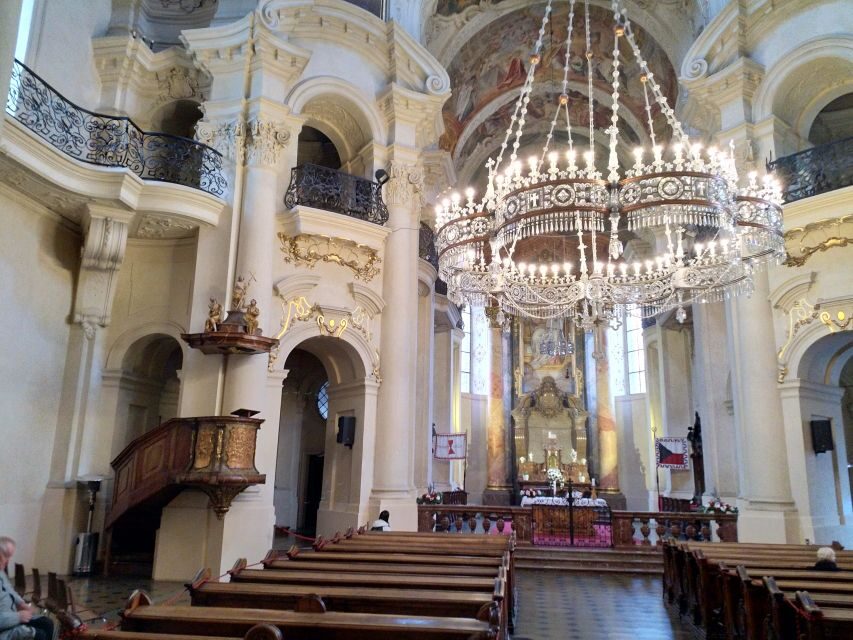
Stop 2 takes you to St Cyril and St Methodius Cathedral. This cathedral is directly tied to Operation Anthropoid, and the tour focuses on the moment when the parachutists involved paid their ultimate price.
The listed time is about 10 minutes, and admission here is free as part of the tour.
Why this matters: cathedrals are often visited for art and architecture, but here it’s different. You’re standing in a place where the mission’s end is anchored. That changes your frame immediately. Instead of looking up at beauty, you’re thinking about consequence.
If you’re someone who likes emotional history, this stop sets the tone for what comes next. If you prefer a lighter tour emotionally, I’d still go—but mentally prepare yourself for the crypt below.
The crypt and Operation Anthropoid museum: what the Heydrich Terror stop does to you
Stop 3 is the one people remember: the National Memorial to the Heroes of the Heydrich Terror. The tour enters the crypt and the Operation Anthropoid museum below the cathedral, described as the place of the last battle where Czechoslovak parachuters paid their ultimate price.
Time-wise, it’s about 20 minutes, and admission is listed as free.
This stop is also the most intense part of the tour. One review note that people can choose not to go into the crypt if it’s too much for them. That’s important. If you want the history but need to protect your mental space, you’re not forced to push through.
What makes the crypt powerful (in a practical sense) is that it gives you physical proof of what the mission cost. You’re not just learning about events; you’re standing in the setting where the aftermath is part of the walls and layout.
You may also find free English-language booklets about the operation in this area. I’d grab them. They help you keep the story straight once you step back into Prague’s normal rhythm.
Timing, walking, and hearing: plan smarter than harder
The tour is listed at 2 to 3 hours, but real life happens. One group reported leaving closer to the 3.5-hour mark and noted that there wasn’t a bathroom break until around the 3-hour point. Another complaint was that the tour can feel long if you’re looking for more light, surface-level facts.
So here’s how I’d plan:
- Wear comfortable shoes. You’ll be on foot for meaningful stretches.
- If you need a restroom, use facilities before the longer segments rather than waiting for a guaranteed mid-tour break.
- Stand where you can hear the guide at the start. Crowd noise at the Powder Gate area can interfere.
- If you’re sensitive to accents or pronunciation differences, bring expectations that English varies by guide and position yourself to reduce audio issues.
Also note the group size: it’s capped at 20 travelers. That helps for questions and pacing, but it doesn’t eliminate motion or the fact that this is a history-heavy itinerary.
Price and value at about $43.53: what you’re paying for
At $43.53 per person, this tour has a fair value profile for what you actually get:
- A small-group format (max 20).
- English-language guiding with explanations connected to each stop.
- Included public transit tickets.
- A lineup of WWII-relevant locations that are hard to stitch together on your own in a coherent story.
- Skip-the-line at the start of the experience.
- Included entry for the underground artifact shelter, and listed free access for the cathedral and memorial/crypt areas.
Is it “cheap”? No. But you’re paying for guided context and for access to specific sites tied to Operation Anthropoid. The tour also saves you the mental labor of planning the route, figuring out transit, and deciding what’s worth your limited time in Prague.
If you’re a WWII fan, it’s especially good value because the guide brings more than basic overview. Multiple guides have been praised for photos, artifacts, and story detail—so you leave with a clearer mental map of Prague’s WWII connections.
Who should book this WWII in Prague tour
This is a strong fit if you:
- Want Operation Anthropoid history in Prague, not just a general “Prague during WWII” overview.
- Enjoy guided storytelling and on-site artifacts.
- Like small groups and question-friendly pacing.
- Are okay with walking and a packed schedule.
It may be less ideal if you:
- Prefer short, casual sightseeing with minimal walking.
- Get overwhelmed by emotional intensity (the crypt stop can be brutal).
- Want only broad, basic facts. This tour is set up as a more focused, connected narrative.
Should you book WWII in Prague Tour & The Crypt of Operation Anthropoid?
If you’re trying to pick one WWII-focused experience in Prague, I’d book this one—especially if Operation Anthropoid is on your list. The combination of street-level context, an underground shelter with artifacts, and then the crypt stop gives you a full arc: lead-up, resistance, and consequence.
Just go in prepared: wear comfy shoes, plan for a longer outing than the minimum on some days, and expect heavier emotions at the end. If that sounds like your kind of history, this tour is one of the most meaningful ways to understand Prague’s WWII story in a few hours.
FAQ
How long is the WWII in Prague Tour & The Crypt of Operation Anthropoid?
It’s listed as about 2 to 3 hours.
What is the meeting point for the tour?
You meet in front of the Powder Tower (110 00 Praha-Praha 1, Czechia).
Where does the tour end?
It ends at Resslova 9, 120 00 Praha 2-Nové Město, Czechia, near the National Monument to the Heroes of the Heydrich Terror.
Is the tour offered in English?
Yes, it’s offered in English.
How large is the group?
The tour has a maximum of 20 travelers.
What’s included for transportation?
The tour includes included public transit tickets, and the day uses a mix of walking and transit.
Are tickets and entry fees included?
The underground site at Dům pánů z Kunštátu a Poděbrad includes an admission ticket. The cathedral and the National Memorial crypt/museum areas are listed as free on this tour.
Is there a crypt visit?
Yes. The tour includes the crypt and the Operation Anthropoid museum beneath the cathedral, and the crypt stop can be emotionally intense.
Can I skip the crypt if it’s too much?
You can choose not to go into the crypt if it’s too much for you.
Can I cancel for a full refund?
Yes. You can cancel up to 24 hours in advance for a full refund.
Is a mobile ticket provided?
Yes, the tour includes a mobile ticket.