REVIEW · PRAGUE
Prague Synagogues and Jewish Quarter Private Walking Tour
Book on Viator →Operated by Private Prague Guide Day Tours · Bookable on Viator
Prague’s Jewish Quarter tells a story you can walk through. This private walking tour focuses on synagogues in Josefov plus the Old Jewish Cemetery, with a local licensed guide who keeps the history clear and personal. I like that the tour starts right near the Astronomical Clock and then eases you into the neighborhood before you jump into the heavier stuff.
I also like the pacing that gives you time to ask questions, not just hurry from door to door. And guides such as Gabriela, Janna, Hannah, Hana, and Gabrielle (names that show up in past tour experiences) are specifically praised for clarity and keeping the group together until key places close.
One drawback to consider: this tour is very stop-and-talk. A review noted slow, repetitive moments and that it can feel longer than expected, with short walking bursts and lots of standing explanations.
In This Review
- Key highlights worth planning for
- A close look at the route: from Old Town Hall to Josefov
- Stop 1: Astronomical Clock area and the entrance to Josefov
- Stop 2: Josefov and the Jewish Museum focus
- Stop 3: Maisel Synagogue (built 1592) and Mordecai Maisel’s impact
- Stop 4: Pinkas Synagogue memorial wall for nearly 80,000 victims
- Stop 5: Old Jewish Cemetery, layered graves, and the golem link
- Stop 6: Klausen Synagogue and the 1689 fire story
- Stop 7: Old-New Synagogue, Kafka’s attendance, and the attic golem legend
- Stop 8: Spanish Synagogue and the Moorish-style Reform interior
- Time, distance, and walking style: what the 2.5 hours really feels like
- Tickets, what’s included, and the one thing to confirm
- The guide factor: why private matters here
- Pricing and value: is $175.24 a fair deal?
- Who this tour suits best (and who might want a different style)
- Quick booking advice: how to make this tour work for you
- Should you book this private Prague Synagogues and Jewish Quarter tour?
- FAQ
- How long is the Prague Synagogues and Jewish Quarter Private Walking Tour?
- Is this tour private?
- Is hotel pickup available?
- What language is the tour in?
- Are tickets included?
- Which sites are part of the tour?
- Does the tour include the Astronomical Clock area?
- Is tipping included in the price?
- Is free cancellation available?
Key highlights worth planning for
- A private guided route through Josefov with only your group, not mixed with strangers
- Multiple major synagogues in one outing, including Pinkas, Maisel, Klausen, and the Old-New
- Old Jewish Cemetery details that stick, including layered graves reaching 12 deep in places
- Holocaust remembrance at Pinkas Synagogue, honoring nearly 80,000 victims from the Czech lands
- Built-in context for legends and names, like the golem story tied to Judah Loew ben Bezalel
- Hotel pickup on foot (not by car) so you start already oriented in the center
A close look at the route: from Old Town Hall to Josefov
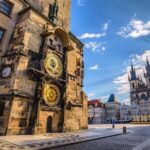
The tour’s starting point is practical: meet under the Astronomical Clock near the Old Town Hall. That matters because it helps you orient fast. You’re in the busiest, most recognizable slice of central Prague, then you slowly shift into the quieter streets of Josefov.
From there, you enter the Jewish Quarter area (Josefov). The best part of starting this way is that it gives you contrast: the Clock is all spectacle and crowds, while Josefov rewards slower attention. I’d call this a tour for people who like to understand a place, not just photograph it.
You can also read our reviews of more walking tours in Prague


Stop 1: Astronomical Clock area and the entrance to Josefov
You’ll meet your guide right under the Astronomical Clock and then step into Josefov. The time at this first segment is short, but the purpose is big: your guide uses the landmark to set the scene.
This first handoff helps if you’ve never been here before. You get a mental map before the synagogues start piling up. If your plan is to see Prague on your own later, this start gives you a reference point for what’s where.
Stop 2: Josefov and the Jewish Museum focus
Next comes Josefov itself, and you’ll hear why it’s so important. Josefov is famous because the area was not destroyed during World War II, which is why so many historic buildings and traces survived here.
The Jewish Museum in this complex covers multiple elements of the community’s heritage—traditions, art, and history—plus an old Jewish cemetery and several synagogues. Even if you’ve read about Prague’s Jewish past, this museum framing makes the sights feel connected instead of random.
One practical note: the tour details say this stop has admission ticket free, while other synagogue stops list admission as not included. Since the package also says Jewish Museum tickets are included, I’d treat this as a reason to double-check what you’ll have on your ticket day. It’s the kind of thing that can save you stress when you’re standing at a desk.
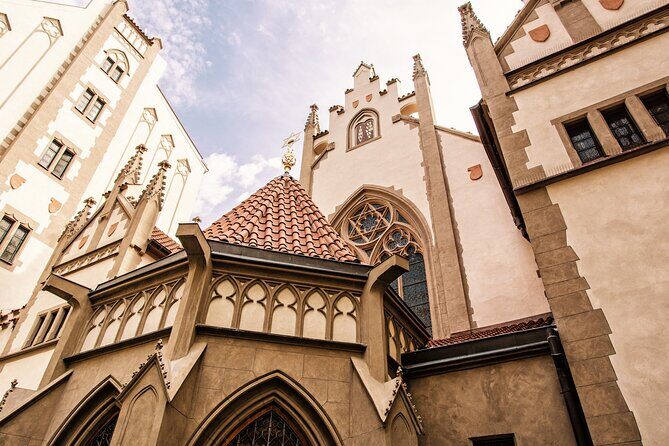
Stop 3: Maisel Synagogue (built 1592) and Mordecai Maisel’s impact
Maisel Synagogue is built in 1592 and named after Mordecai Maisel, a major local figure. He wasn’t just a donor; the details explain he served as mayor of the Jewish town and sponsored a wide range of community needs.
What I like about this stop is how it connects architecture to everyday life. The story includes funding for a public bathhouse, ritual baths, an almshouse, the Jewish town hall, and other synagogues. That turns the synagogue from a standalone building into a “community hub” in your head.
If you only do one historical synagogue on your own trip, make it one that ties to social history like this. It’s easier to remember, and the tour’s guide time here is well spent.
Stop 4: Pinkas Synagogue memorial wall for nearly 80,000 victims
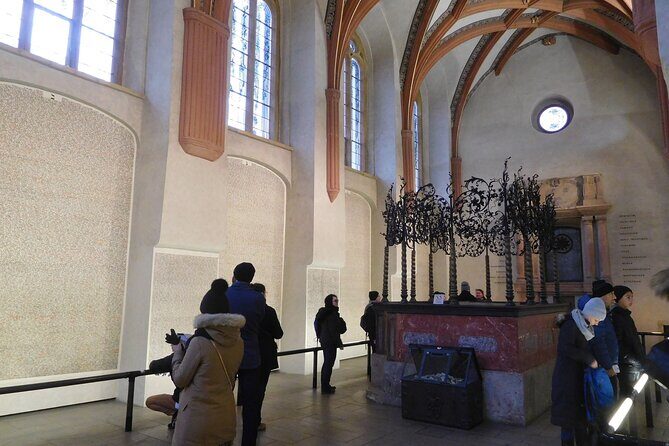
Pinkas Synagogue (from 1535) is the emotional center of this route. It’s part of the Jewish Museum and serves as a memorial to nearly 80,000 Jewish victims of the Holocaust from the Czech lands.
This stop is not just a visit to an old room. It’s a pause for meaning. The layout becomes part of the message, and your guide’s role matters here—because you need the context to avoid skimming what’s in front of you.
Timing helps too. The tour description emphasizes that the schedule leaves room to learn and ask questions, which is exactly what you want at a memorial site. If you have family history from the region, or you’re sensitive to Holocaust memorials, plan to slow down here.
You can also read our reviews of more private tours in Prague


Stop 5: Old Jewish Cemetery, layered graves, and the golem link
The Old Jewish Cemetery is one of Europe’s largest Jewish cemeteries still tied to ancient burial grounds. It operated from the 15th century to the late 18th century, and roughly 80,000 residents of the Prague ghetto were buried here.
Here’s one detail that really changes how you see the place: tombs are layered on top of each other, with one section reaching 12 layers. That’s not a poetic exaggeration in the tour notes—it’s a literal feature of how the cemetery coped with space across generations.
You’ll also hear about rabbi Judah Loew ben Bezalel, a prominent personality buried here. He’s linked to the golem legend, a mud figure reportedly summoned to life for protection against anti-Semitic attacks. Whether you treat it as folklore or cultural memory, the tour makes the legend feel rooted in the neighborhood’s identity.
This is also where comfort matters. Even if the walking distance is modest, cemetery visits can mean standing still for long moments of explanation.
Stop 6: Klausen Synagogue and the 1689 fire story
Klausen Synagogue is described as the biggest synagogue in Prague’s Jewish Town. The name Klausen originally referred to three smaller 16th-century buildings on the site, including a yeshivah (Talmudic school) connected to Rabbi Loew.
Then comes the key historical turn: after a ghetto fire in 1689, Klausen Synagogue was erected on the site in 1694, in an early Baroque style. That sequence helps you understand the building as part of recovery, not just survival.
I like this stop for how it answers a hidden question: why do these synagogues look different from one another? The guide can connect style changes to historical events like fires and rebuilding periods.
Stop 7: Old-New Synagogue, Kafka’s attendance, and the attic golem legend
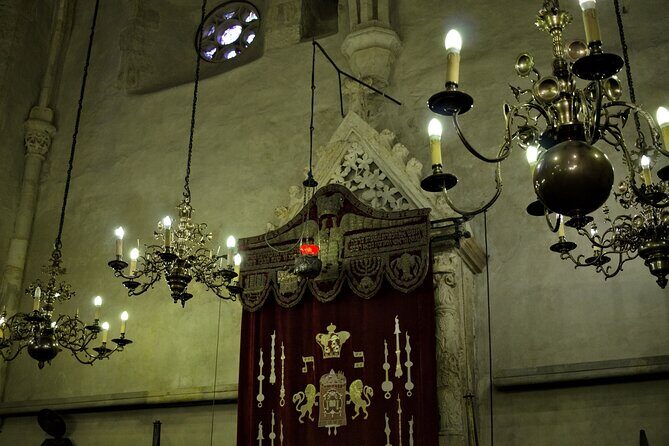
The Old-New Synagogue is Gothic Cistercian and built in the latter part of the 13th century, making it the oldest building in the Jewish Town and one of Europe’s oldest synagogues still in use. You’ll also hear Franz Kafka attended services here.
Then there’s the legend: a golem hidden in the attic. I’d treat that as a story your guide uses to bring the place to life, not as a checklist item. The real value is the connection between daily worship, literary history, and the community’s legends.
If you like when a city’s culture overlaps across centuries, this is the stop that does it. Kafka gives you a familiar Prague name; the synagogue gives you the local context.
Stop 8: Spanish Synagogue and the Moorish-style Reform interior
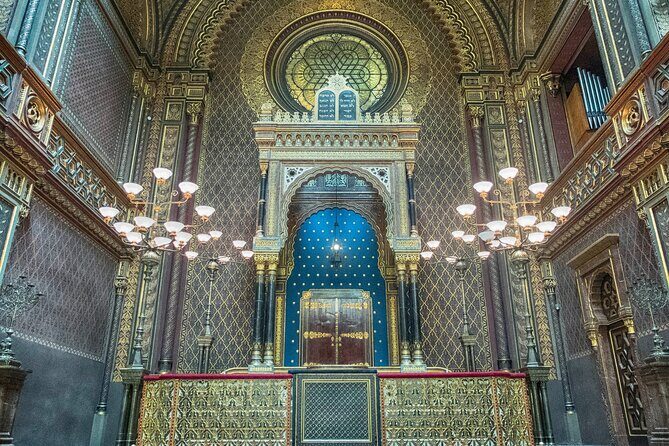
The Spanish Synagogue is the most recent synagogue in the Prague Jewish Town, built in 1868. It was created for the local Reform congregation on the site of an earlier 12th-century synagogue called Altschul.
It’s called Spanish because of the Moorish interior design, influenced by the Alhambra. This is a great final stop because it shows how Jewish worship spaces in Prague weren’t frozen in time. They changed with movements in Europe, and your guide helps you see that shift.
If you’ve been thinking this tour is only about medieval Prague, the Spanish Synagogue corrects that view fast.
Time, distance, and walking style: what the 2.5 hours really feels like
The tour runs about 2 hours 30 minutes. That can sound quick until you factor in how many major stops are packed into that time. You’re not just walking between points—you’re stopping for guided explanations inside or at entrances.
One review noted that walking itself was limited (about 1.7 miles total) while pacing felt slow, with frequent stop-go moments. That lines up with how synagogue and cemetery tours usually work: the value is in the stories and details, not in covering ground.
If you’re someone who loves to move while you listen, this may feel different than a “fast highlights” city tour. If you like a steady pace and time to ask questions, this format can be a plus.
Tickets, what’s included, and the one thing to confirm
The package includes Jewish Museum tickets. That’s important because you’re visiting multiple museum-linked sites tied to the Jewish Quarter.
At the same time, the stop notes label some admissions as not included (for Maisel, Pinkas, cemetery, Klausen, Old-New, and Spanish Synagogue). That could mean tickets are handled within the Jewish Museum system, or it could mean certain doors require separate payment.
To stay stress-free, I’d confirm exactly what your ticket covers for your date. You should have enough written detail from booking to know whether you’re paying at the door or using your included tickets.
Also note: tip isn’t included. If this is your only paid guided tour in Prague, I’d plan a tip budget.
The guide factor: why private matters here
This is a private walking tour. Only your group goes, so you’re not competing with strangers for attention at sensitive stops like Pinkas Synagogue or the Old Jewish Cemetery.
From the reviews, guides like Gabriela, Janna, Hannah, Hana, and Gabrielle are singled out for knowledge and a pace that doesn’t feel rushed. One review specifically highlighted a guide who made sure they saw everything before closures. That’s a big deal here because synagogue visits can have time limits.
In private format, you can also ask clarifying questions that you might hold back in a larger group. If you’re wondering about the golem legend, Holocaust memorial context, or why each building looks different, this tour format gives you time to ask.
Pricing and value: is $175.24 a fair deal?
At $175.24 per person for about 2.5 hours, this isn’t a budget add-on. But it can be fair value because you’re paying for a licensed guide plus Jewish Museum access tied to several major sites.
You’re also buying time management. The route includes stops that are famous individually, but trying to piece it together yourself usually takes more effort than you expect—especially if you want a coherent story and not just a list of buildings.
That said, if you’re traveling as a solo person, the cost can sting. If you’re a small group (two to four people), the private nature starts to feel more reasonable because the guide stays focused on your pace and questions.
Who this tour suits best (and who might want a different style)
This tour fits well if you:
- Want Prague Jewish Quarter synagogues connected by a clear narrative
- Prefer a private pace with time for questions
- Like stories tied to specific places, including legends like the golem
It might not be ideal if you:
- Want constant movement and minimal standing
- Get impatient with repeating context or longer pauses at memorial sites
- Prefer a self-guided option where you can control every minute
If you’re older or have mobility limits, the stop-and-talk style can be manageable since walking is relatively limited. Just be ready to stand during explanations.
Quick booking advice: how to make this tour work for you
- Wear comfortable shoes. You’re on foot and you’ll spend time standing at several sites.
- Bring a question list. Things like the golem legends, Rabbi Loew’s connection to community protection, and why synagogues rebuilt after events like the 1689 fire matter more when you ask.
- Confirm exactly which Jewish Museum tickets you’ll use for each synagogue stop. The included line and the stop notes don’t read perfectly the same, so a quick check saves headaches.
- If you care about closures, plan to arrive a bit early. One of the best outcomes in past experiences is making it to key interior moments before closing.
Should you book this private Prague Synagogues and Jewish Quarter tour?
I’d book it if you want a guided, meaningful route through Josefov that connects the synagogues, the cemetery, and the big historical events without turning it into a rushed checklist. The tour’s structure is built for understanding—especially at Pinkas Synagogue and the Old Jewish Cemetery, where context really matters.
Skip it or consider a different format if you’re chasing maximum walking or you hate long pauses. Based on the pacing feedback, this is a tour where you should expect lots of standing for stories.
If your goal is to leave Prague with a clearer picture of how this quarter evolved—and why these buildings still matter—this private tour is a strong choice.
FAQ
How long is the Prague Synagogues and Jewish Quarter Private Walking Tour?
It runs about 2 hours 30 minutes.
Is this tour private?
Yes. It’s a private tour, so only your group participates.
Is hotel pickup available?
Pickup is offered at your hotel reception or another location in the city center, but it’s on foot (not by car). You’ll provide your Prague address.
What language is the tour in?
The tour is offered in English.
Are tickets included?
Jewish Museum tickets are included. Some stops in the tour details also list admission as not included, so it’s smart to confirm what your tickets cover for your date.
Which sites are part of the tour?
You’ll visit several synagogues and sights in Josefov, including Maisel Synagogue, Pinkas Synagogue, the Old Jewish Cemetery, Klausen Synagogue, the Old-New Synagogue, and the Spanish Synagogue.
Does the tour include the Astronomical Clock area?
Yes. You meet under the Astronomical Clock and then enter the Jewish Quarter.
Is tipping included in the price?
No. Tip is not included.
Is free cancellation available?
Yes, you can cancel up to 24 hours in advance for a full refund.