REVIEW · PRAGUE
Prague Cold War Walking Tour
Book on Viator →Operated by Insight Cities · Bookable on Viator
Cold War Prague has a heartbeat.
This 3-hour Prague Cold War Walking Tour guides you through the communist-era landmarks that shaped everyday life in Czechoslovakia, from propaganda-heavy monuments to places tied to political protest. You start near Náměstí Republiky and move on a route designed to help the big history feel specific, street by street, corner by corner.
I especially love two things about it. First, you get a historian guide who turns the slogans into real political choices, including how propaganda shows up in statues and museum-like spaces. Second, this runs as a small group (max 8), which makes it easier to ask questions without the tour feeling like a lecture line.
The one drawback to plan around is the steep climb up to Vitkov Hill—the monument area takes about 20–30 minutes uphill. If hills are hard for you, the operator notes you should consider a private tour that skips Vitkov Hill, since that part is a dealbreaker for some people.
In This Review
- Key highlights worth your attention
- Why this Cold War walk works in Prague
- Starting at Náměstí Republiky: where the tour sets its tone
- Stop 1: the Karlin–Žižkov pedestrian tunnel and the psychology of control
- Vitkov Hill: Gottwald’s presence, the Soviet Soldier hall, and the climb factor
- Prague TV Tower on Žižkov: a sharp turn from monuments to views
- Wenceslas Square: the timeline of Czech upheaval
- Propaganda, protest, and the spaces where power sat
- Pace, group size, and what to bring for a smooth 3 hours
- Price and value: is $126.43 a good deal?
- Who this tour is best for (and who should skip it)
- Should you book the Prague Cold War Walking Tour?
- FAQ
- Where does the Prague Cold War Walking Tour start?
- How long is the tour?
- Is the tour in English?
- Is this a large group tour?
- Does the tour include tram tickets?
- Is the Vitkov Hill monument admission included?
Key highlights worth your attention
- Historian-led route: you’ll connect communist ideology to what you actually see on the streets.
- Cold War “fear infrastructure”: you’ll walk the Karlin–Žižkov pedestrian tunnel and notice doors still guarding Cold War corridors.
- Vitkov Hill’s political theater: Gottwald’s mausoleum area and the Hall of the Soviet Soldier/Red Army sit inside one major monument complex.
- Bold Prague contrasts: Brutalism and TV-tower views show up right after the heavy monument stops.
- Big turning points in one square: Wenceslas Square is treated as a timeline—parades, Prague Spring tragedy, then the Velvet Revolution.
- Satire with a point: the upside-down King Wenceslas statue makes you think about how politics changed—and what jokes still carry.
Why this Cold War walk works in Prague
Prague can look like a postcard: stone streets, grand squares, and bridges that make you stop for photos. But this tour asks you to look past the scenery and read the city like evidence. Communist rule didn’t only control laws and jobs—it shaped what people were allowed to see, what they were expected to believe, and how power wanted to look in public.
What makes this experience click is the balance between ideology and physical places. You won’t just hear that the regime used propaganda. You’ll stand near statues, memorial spaces, and protest sites and talk through what those symbols were meant to do to everyday people.
Also, the pacing is built for a single story, not five unrelated stops. After three hours, you should have a clearer picture of how communism rose in Czechoslovakia, what the Velvet Revolution changed, and why echoes of that era still show up in modern Czech life.
You can also read our reviews of more walking tours in Prague
Starting at Náměstí Republiky: where the tour sets its tone
You meet at Náměstí Republiky 1077/2 in Prague’s Old Town area (Nové Město), then you head out on foot. Start time depends on whether you pick the afternoon or morning departure, but the schedule you’re given includes an afternoon start at 2:00 pm.
This location matters because it gives you quick access to the route’s main “threads.” You’re not stuck far out in the suburbs; you’re moving through central Prague where the Cold War story is literally layered on top of older history.
Practical tip: wear comfortable walking shoes and plan for stairs and uphill sections. The tour includes a steep climb up to Vitkov Hill, and even if you’re fit, it’s the kind of hill that slows groups down.
Stop 1: the Karlin–Žižkov pedestrian tunnel and the psychology of control
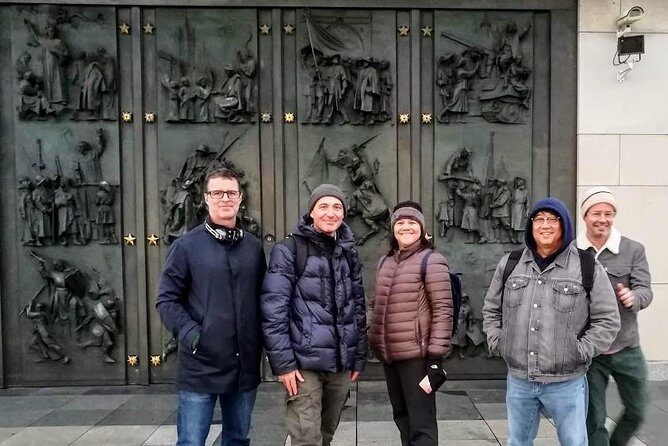
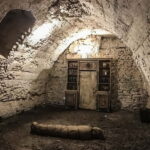
One of the most memorable moments is the first walking segment through the Pedestrian Tunnel Karlin–Žižkov. You’ll pass through and look at locked doors that lead to nuclear bomb-shelter corridors built during the Cold War and still maintained.
This isn’t a museum stop with glass cases—it’s the kind of place that makes the history feel physical. The tunnel’s purpose was practical, but the real point is psychological: the regime era wasn’t only about ideology and speeches. It was also about preparedness, fear, and planning for the worst.
Time-wise, it’s quick—about 10 minutes—and it’s free. You’ll use it like a preface. After this, the major monument stops don’t feel abstract. You can start thinking about how states prepare people to accept risk, discipline, and uncertainty.
Vitkov Hill: Gottwald’s presence, the Soviet Soldier hall, and the climb factor
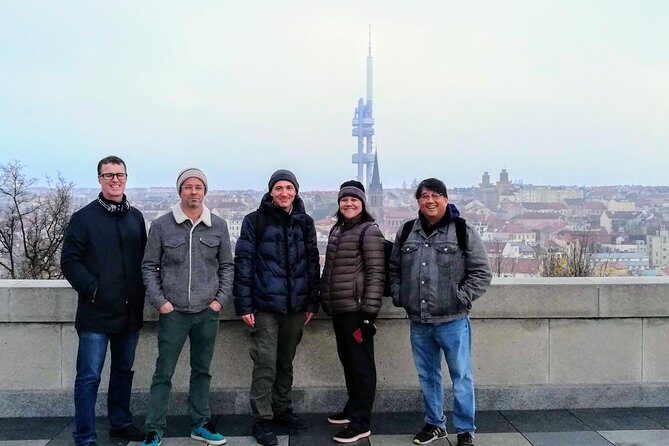
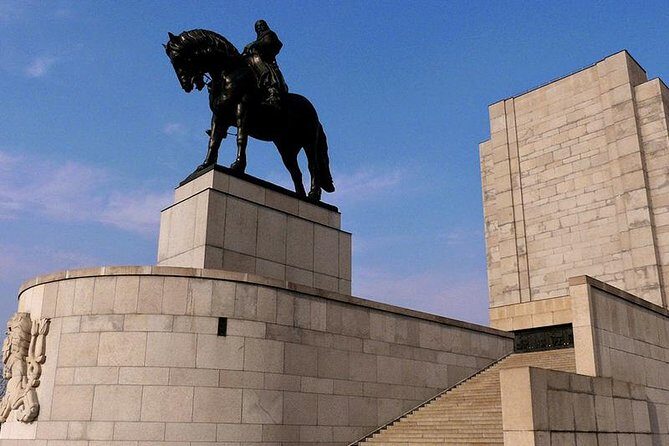
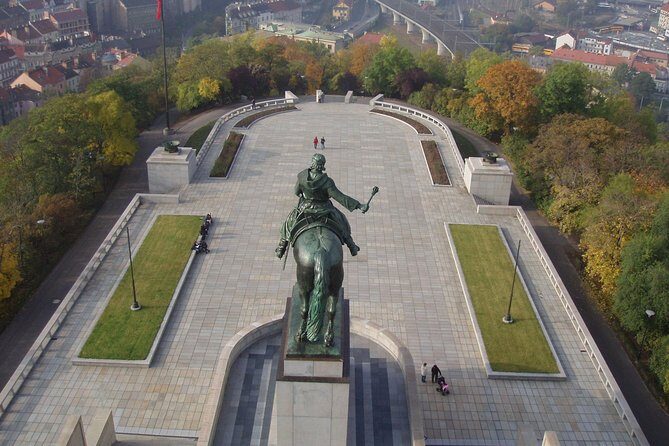
Vitkov Hill is the tour’s heavy anchor. You spend about 1 hour in the monument area, and yes, it requires effort—expect that 20–30 minutes uphill climb before you fully settle into the site experience.
This is where the tour really commits to the communist power story. You’ll see the National Monument tied to Czech and Slovak WWI commemorations, but the tour’s focus shifts into the communist layer of meaning. You’ll visit the Hall of the Soviet Soldier and the former mausoleum connected with Klement Gottwald, the first chairman of the KSC. The tour also points out the adjoining laboratory where his body was embalmed.
A big reason this stop is so valuable is that it shows how the regime used bodies, buildings, and ritual spaces together. Even when people disagree about politics today, it’s hard not to notice how seriously the communist government treated symbolism—especially when it put an embalmed leader into a memorial framework.
You’ll also meet a giant statue presence: Jan Žižka, tied to Czech national memory, represented by a major bronze equestrian statue in the complex. The tour connects this to how Czech nationalism influenced communist rule.
Two important practical notes:
- The monument admission is not included, so you’ll need to plan for that cost.
- If hills are difficult for you, the operator specifically recommends a private tour that skips Vitkov Hill so you can still do a strong Cold War route in the city center.
Prague TV Tower on Žižkov: a sharp turn from monuments to views
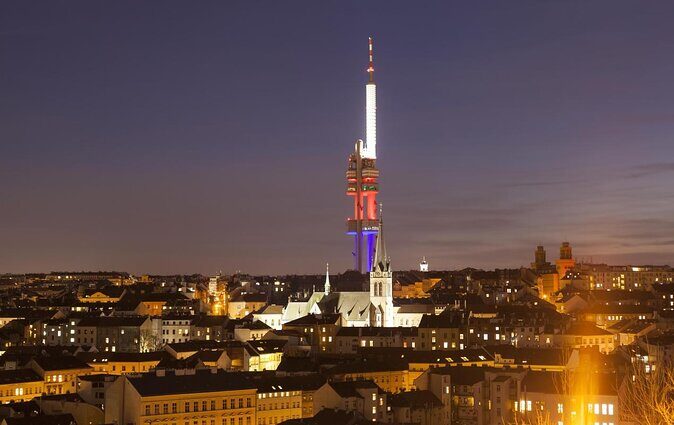
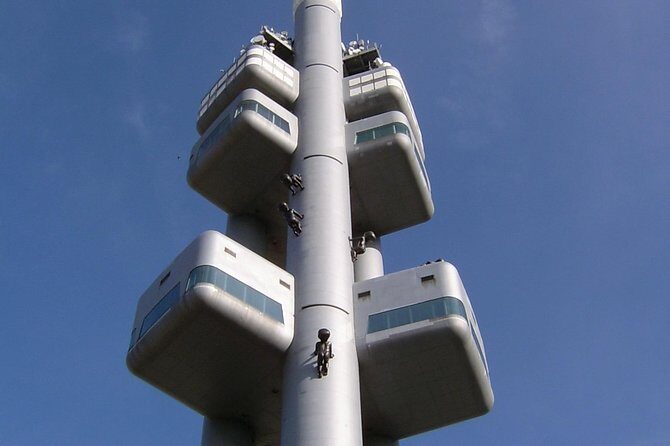
After the dense monument stop, the tour hands you a different kind of Prague. You briefly reach the Žižkov Television Tower for the best view of the Brutalist style tower.
This stop is short—around 5 minutes—and it’s free, but it does something important: it gives your brain a visual reset. Brutalist structures tend to feel like statements made of concrete, and that works well after monument-heavy communist architecture. You start comparing old power language with a newer era’s style of emphasis.
If you’re photographing: take a moment, look up, and then look around. The tower is meant to be seen as an object, but it also helps you understand the surrounding neighborhood layers.
Wenceslas Square: the timeline of Czech upheaval
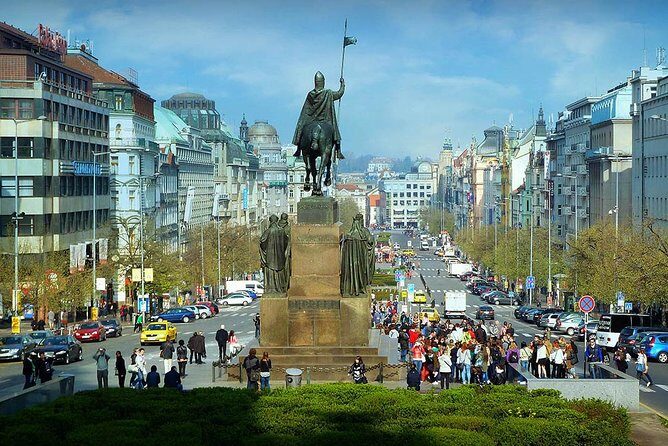
Then you reach Wenceslas Square, which the tour treats like an outdoor timeline. You’ll walk through and connect its history from its founding in the 14th century to the more recent, darker chapters tied to occupation and political protest.
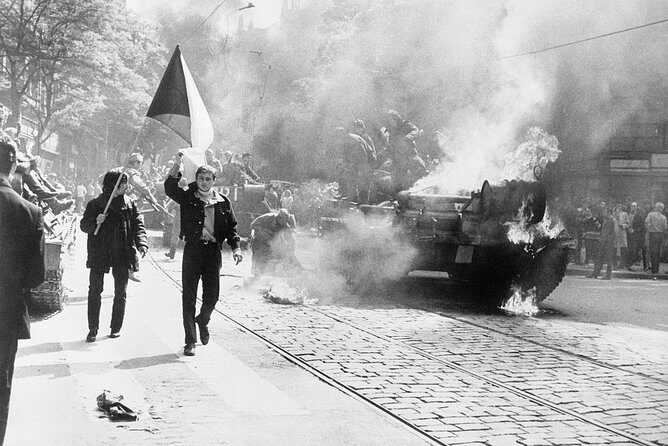
The Cold War focus lands on how the square handled public power: you’ll consider military parades of occupying powers, then move through the tragic events of Prague Spring, and finally the ecstatic gathering of the Velvet Revolution that ignited in a single day.
This stop matters because square history is different from museum history. Streets remember. You can stand in one place and feel how the same open space could be used for ceremony, control, and then revolt.
Time-wise, you get about 20 minutes here, and everything is free. If you’re the kind of person who likes to read plaques slowly, you may want to slow your pace inside the time window and soak up the key meanings your guide emphasizes.
Propaganda, protest, and the spaces where power sat
Beyond the numbered stops, the route includes several essential communist-era themes that you’ll notice as you walk.
You’ll look at the statues and decorations connected to the communist “elegant coup” of 1948, including the messaging language tied to KSC propaganda and politics. You also go to the kind of site where the communist government made itself visible—places like the National Assembly building, described as the seat of the Communist government.
Then the tour flips the mood with political dissent sites. You’ll visit the John Lennon Wall, known as a focal point for protest. Seeing it during a Cold War-focused walk makes it feel more like an alternative system of communication than just street art.
The tour also brings in Letná Hill, where you hear the story of a former enormous Stalin statue and what happened to its sculptor. That’s a strong way to understand how regimes try to create permanent symbols—and how those symbols can fall, change meaning, or get erased as politics shifts.
And finally, the route includes an ironic reminder that Czech political memory isn’t only solemn. The upside-down Statue of King Wenceslas riding a Dead Horse is there to spark conversation about contemporary Central European politics and how satire survives even after regime change.
Pace, group size, and what to bring for a smooth 3 hours
This tour is designed for a maximum of 8 travelers, which is the difference between a quick history talk and a real back-and-forth conversation. It also means the guide can shift the pace if people have questions, especially around the more complex political parts.
The tour lasts about 3 hours (approx.), and it’s a steady walk with stops that vary from quick viewing points to heavier time on the monument complex at Vitkov Hill.
What to wear:
- Comfortable shoes for uneven pavement and stairs.
- A layer for weather. Prague can change fast, and you’ll be outside for long stretches.
- If you’re worried about the uphill segment, be honest with yourself about your stamina. The operator explicitly flags the Vitkov Hill climb for people with difficulty.
What you’ll get included:
- A historian guide.
- Tram tickets (so you’re not paying out of pocket for public transit between points on your route).
- A mobile ticket approach is included.
Price and value: is $126.43 a good deal?
At $126.43 per person, this isn’t a bargain-basement walk. But it’s priced like what you’re buying: a historian-led tour with a small group and tram support, focused on specific places rather than vague “see the highlights” sightseeing.
Here’s the value breakdown in plain terms:
- You’re paying for an expert guide who can explain communist politics in a way that makes sense when you’re standing in front of a monument.
- You’re also paying for time efficiency—the route is planned to take you to key sites without you piecing together transit and museum logistics.
- Tram tickets are included, so part of the usual city walking “extras” is handled.
What isn’t included:
- Vitkov Hill monument admission is listed as not included. That’s the one extra you should budget for, because that’s the main ticketed area on the route.
If you want Cold War context but you don’t want to spend hours figuring out connections and entrances yourself, this price can feel fair. If you’re comfortable skipping guide interpretation and just wandering, then it might feel expensive. But if you want the politics to click, the guide component is the real value driver.
Who this tour is best for (and who should skip it)
This is a good fit if you:
- Like history that connects to physical places, not just timelines.
- Want a politics-and-symbols explanation rather than a general Prague sightseeing loop.
- Appreciate a small group setting where questions can actually land.
It’s less ideal if:
- You can’t manage the uphill climb to Vitkov Hill. In that case, the operator recommends a private alternative that avoids Vitkov Hill while still covering Cold War sites in the city center.
Should you book the Prague Cold War Walking Tour?
I’d book it if you want a thoughtful Prague experience that goes beyond the postcard layer and into how communist power worked day to day—through monuments, propaganda, and protest.
Book it especially if you like tours where the guide keeps history grounded in what you can see: tunnels built for nuclear fear, memorial spaces tied to specific leaders like Klement Gottwald, and open squares where Czech political life changed fast.
Skip it or consider a private variant if Vitkov Hill hills are hard for you. That one part can control the whole experience. If you can handle the climb, this is one of the more focused ways to understand 20th-century Czechoslovakia in just a few hours.
FAQ
Where does the Prague Cold War Walking Tour start?
The tour starts at Náměstí Republiky 1077/2, Nové Město, 110 00 Praha-Praha 1, Czechia.
How long is the tour?
It runs for about 3 hours.
Is the tour in English?
Yes, it’s offered in English.
Is this a large group tour?
No. This experience has a maximum of 8 travelers, so it stays fairly small.
Does the tour include tram tickets?
Yes. Tram tickets are included.
Is the Vitkov Hill monument admission included?
No. The Vitkov Hill monument admission is not included, while other parts of the route include free stops.