REVIEW · PRAGUE
Prague Old Town New Town and Jewish Quarter Morning Tour
Book on Viator →Operated by Explore Prague · Bookable on Viator
Prague feels bigger when you walk it. This 3-hour morning tour strings together major Prague sights on foot while your guide adds the why behind the what, from revolution-era squares to synagogue stories. I love the licensed guide-led pacing that keeps the route moving without turning your brain into soup. The one possible drawback: it covers a lot in a short time, so if you want a very deep, hours-long focus on the Jewish Quarter, you’ll likely want to continue on your own after.
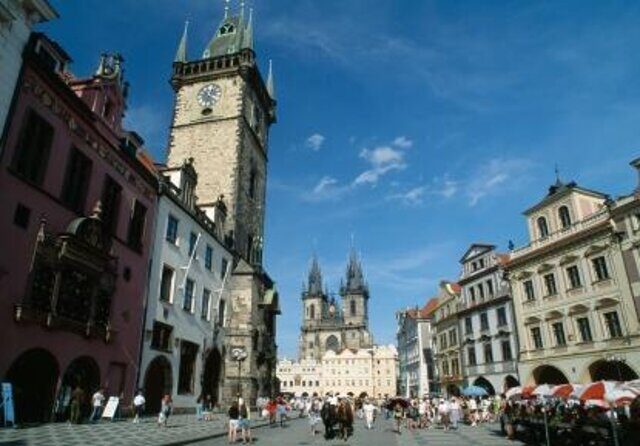
You start on Wenceslas Square and end in Old Town Square in front of the Astronomical Clock. Along the way, you’ll see a mix of Gothic, Baroque, Art Nouveau, and street-level details like architecture types and street-side legends. It’s offered in English, runs in all weather, and keeps groups to a maximum of 20, which helps you hear the stories and still move at a decent clip.
In This Review
- Key things I’d watch for on this Prague walk
- Wenceslas Square to Lucerna Arcade: the avenue where Prague shows its muscle
- Franciscan Garden and Church of Our Lady of the Snows: quiet air, then a church with a twist
- Estates Theatre, Karolinum, and the House of the Black Madonna: culture gets argued into existence
- Powder Tower and Municipal House: from a city gate to Art Nouveau pride
- Church of St. James and the walk toward Old Town Square: Baroque drama on busy streets
- Jewish Quarter in a focused morning: Spanish Synagogue, Old-New Synagogue, and the Old Jewish Cemetery
- Old Town Hall and the Astronomical Clock: end at the moment everyone gathers
- Price and value: what $32.65 buys you in three hours
- Pace, group size, and what to expect from the guide’s English
- What to know before you go: shoes, weather, and ticket planning
- Should you book this Prague Old Town New Town and Jewish Quarter morning tour?
- FAQ
- How long is the Prague Old Town, New Town and Jewish Quarter morning tour?
- Where does the tour start and end?
- Is the tour in English?
- Is the tour admission-free at each stop?
- How big is the group?
- Does it run in bad weather?
- Can I cancel for a full refund?
Key things I’d watch for on this Prague walk
- A route that ties Old Town, New Town, and the Jewish Quarter into one morning
- Short stops at big landmarks so you get orientation fast, especially on a first visit
- Local-feeling pauses, like Franciscan Garden, where you can breathe between busy streets
- Stops that explain architecture, not just name-drop buildings (altars, theatres, synagogue types)
- A finish at the Astronomical Clock so you’re already in the right place for your next move
Wenceslas Square to Lucerna Arcade: the avenue where Prague shows its muscle
Most morning tours start with a plaza. This one starts with a statement: the top of Wenceslas Square, a real stage for big 20th-century moments, from revolutions to military parades. Even if you don’t know the details yet, standing here gives you context. Prague didn’t just get pretty buildings. It also got history played out in public.
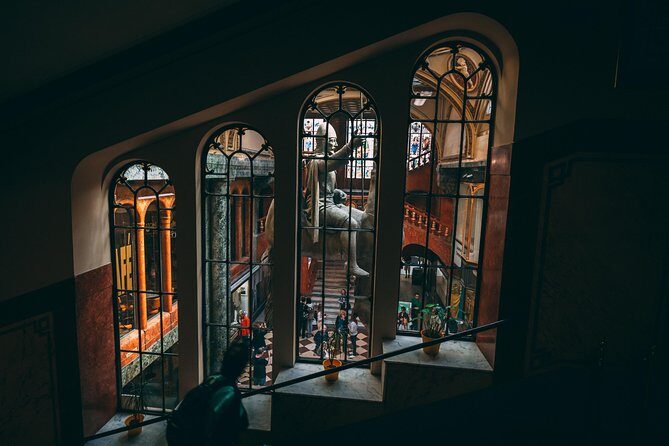
From there, you head toward Lucerna Arcade and the Lucerna palace area, including a stop connected to the David Černý upside-down horse statue. This is the kind of detail that’s easy to miss if you’re just snapping photos. On a guided walk, you get the reasoning behind why it’s there and how modern Czech design sits cheek-by-jowl with older Prague grandeur.
I like that this section balances power and weirdness. You get the political scale, then you get a wink of contemporary art. That mix keeps the morning from feeling like a textbook.
You can also read our reviews of more tours and experiences in Prague

Franciscan Garden and Church of Our Lady of the Snows: quiet air, then a church with a twist
Then the tour slows down in the best way. Franciscan Garden is the break you didn’t know you needed: a calmer pocket where you can feel the city’s rhythm drop. It’s short, but it changes how you experience the rest of the walk. After this pause, the crowded streets feel different.
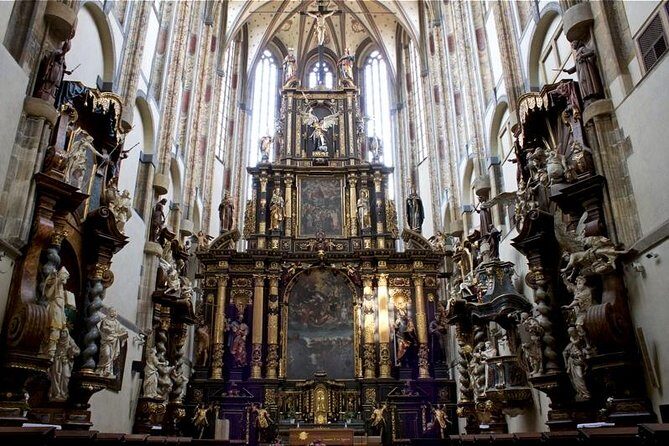
Right near the garden is the Church of Our Lady of the Snows, Gothic in style, with an odd backstory. It was meant to become the greatest church in Prague, but it never got finished. Still, what’s inside matters—especially because it houses the tallest altar in Prague. That detail alone is worth showing up for, because it answers the question you might not think to ask: how can something unfinished still become important?
Practical note: with these two stops back-to-back, I’d mentally plan on a short hop from quiet to impressive. If you’re the type who likes architecture stories, this is where the tour starts earning its keep.
Estates Theatre, Karolinum, and the House of the Black Madonna: culture gets argued into existence
Next comes the theatre-world history at Theatre des Etats (the Estates Theatre). The big headline is that Mozart performed in Prague. But the deeper point is why the theatre was controversial. The guide explains how locals opposed its construction, which is a great reminder that cultural landmarks often come with conflict, not just celebration.
From there you’re near Karolinum, tied to Charles University. You learn about Charles IV and why he’s such an important figure in Czech history. Even if you’ve heard the name before, it lands differently when you connect a ruler to a university building that still anchors the city.
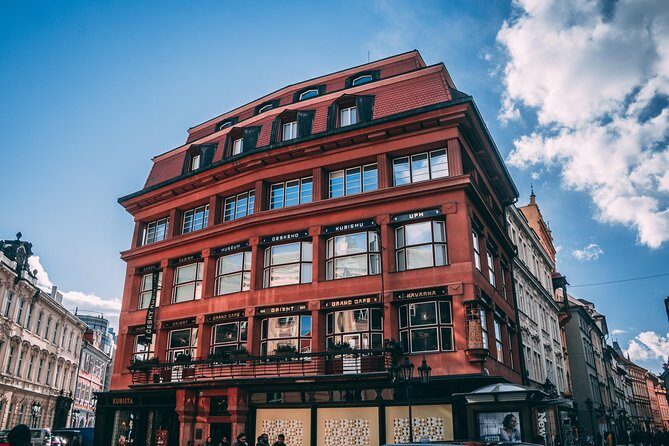
Then you get a stop connected to the House of the Black Madonna, where the focus is on Czech architectural style. This isn’t just decoration talk. It’s about how local aesthetics and identity show up in ways you can recognize once your guide points them out.
If you like your sightseeing with context—who wanted what, who objected, and how it shaped the streets—this stretch is one of the strongest.
Powder Tower and Municipal House: from a city gate to Art Nouveau pride
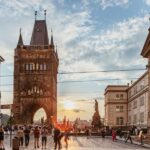
Prasna brana, the Powder Tower, is the sort of structure that looks like a simple photo stop until you hear the story. It used to be a representative entrance into the Old Town. Later, it became a storage facility. That shift from ceremonial gate to practical use is exactly the kind of transformation you miss without guidance.
Right next to it is Obecní dům, the Municipal House—Prague’s Art Nouveau “pearl,” with a style that’s hard to ignore once you see it up close. This is one of those stops where your brain finally realizes Prague isn’t one style. Gothic, Baroque, and modern European design all coexist within minutes.
One small consideration: several of these sights are listed without admission tickets included. So expect that you may see a lot from outside, or you may have the option to purchase entry if you want to go in for the interior experience.
Church of St. James and the walk toward Old Town Square: Baroque drama on busy streets
You’ll add more church time with the Church of St. James. This is the big Baroque church of the Old Town, and the tour encourages you to take a good look at its interior. If you’re a fan of ornate detail, this stop is a satisfying payoff after the earlier theatre and synagogue context.
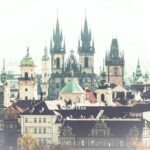
After that, your walking route naturally funnels you toward Staroměstské náměstí (Old Town Square). This is where Prague becomes a stage again, but now it’s about architecture variety and landmark density. The guide ties in key sights like St. Nicholas Church, Týn Church, the statue of Jan Hus, and the Column of St. Mary.
I like how the square is treated as a story with multiple chapters. Instead of you memorizing five names, you learn what makes the space feel layered—different centuries, different intentions, one central stage.


Jewish Quarter in a focused morning: Spanish Synagogue, Old-New Synagogue, and the Old Jewish Cemetery
The Jewish Quarter portion starts with the Spanish Synagogue area and includes a reference to Franz Kafka via a statue connected to a writer from Prague. Then you get the larger context: why Prague had significant Jewish ghettos and how the Jewish Quarter story evolved from medieval times to the present.
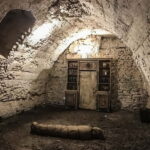
Next is the Old-New Synagogue, described as Prague’s oldest synagogue. Your guide explains its story and adds the neighboring synagogue picture—High Synagogue, Klausen Synagogue, and the Ceremonial Hall. This matters because synagogues here aren’t isolated. They’re part of a network of religious life and community practice.
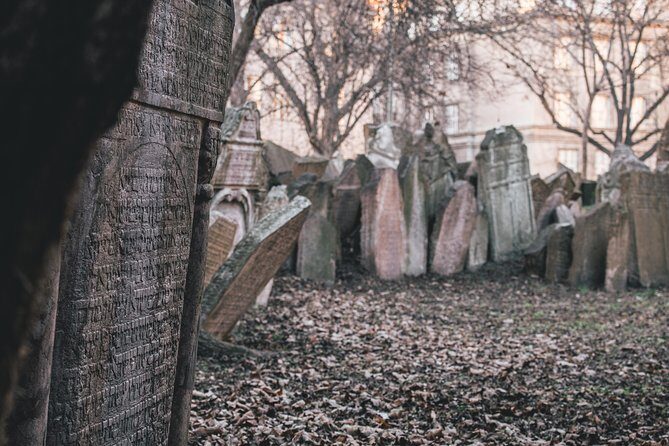
Finally, the tour reaches the Old Jewish Cemetery. It’s described as extensive and also as one of the few old Jewish cemeteries that survived World War II. That alone is heavy enough that you don’t need extra theatrics. You leave with a real sense of how time, survival, and place can sit next to each other on the same street.
One honest heads-up: the name of the tour includes the Jewish Quarter, but the day also covers major Old Town and New Town landmarks. If you want a purely Jewish Quarter-focused morning, you’ll still learn a lot here—just don’t expect the entire route to be only synagogues and cemetery time.
Old Town Hall and the Astronomical Clock: end at the moment everyone gathers
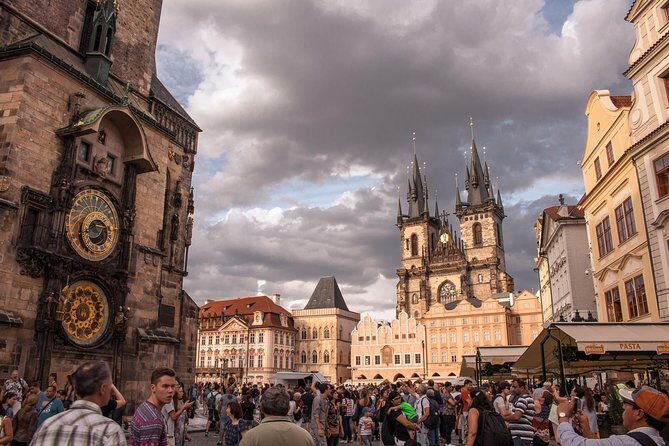
Your final stop is Old Town Hall and the Astronomical Clock at the top of the Old Town Square scene. The tour’s approach here is practical. You learn when the clock was built, how the complex mechanism works, and then you can watch the show of the full hour.
This ending works well for your schedule. After three hours, you’re already in the heart of the action, so you can keep exploring without re-locating or guessing where the next landmark is. The guide also shares tips for what to do next in Prague, and there’s even an invitation mentioned for an afternoon walk toward Prague Castle.
Note on tickets: the Astronomical Clock stop is listed without admission tickets included. That doesn’t stop the main experience, but it might affect whether you can access specific interior areas tied to Old Town Hall.
Price and value: what $32.65 buys you in three hours
At about $32.65 per person for roughly three hours, the value is in three places: your guide, your time, and your route efficiency.
- You get a professional licensed guide, not just a self-guided route with a map.
- Many stops are marked with free admission, which helps keep costs down while you still get variety across architecture and civic buildings.
- The route is designed for orientation. In a short morning, you learn the shape of central Prague—where major squares sit, how neighborhoods connect, and which buildings you’ll want to revisit later.
Where the math can shift: a few stops are listed with admission not included (like Theatre des Etats, Karolinum, and several Jewish Quarter sites). If you want to go inside at every listed stop, plan for extra ticket costs.
Still, for first-time orientation and a strong cross-section of Prague styles and stories, the pricing feels fair.
Pace, group size, and what to expect from the guide’s English
Group size is capped at 20, and that’s a big deal in a walking tour. Smaller groups mean fewer people blocking your view and less time lost repeating yourself between stops.
English is listed as the tour language, and past guides have been praised for pacing and making questions easy to answer. In particular, guides like Petra and Jack/Honza (also seen as Honza and Jac in different bookings) show up in the strongest feedback for clarity, friendliness, and good timing. Petra gets especially strong nods for pacing and for stopping for coffee to warm up when it’s cold.
That said, there are a couple of real considerations to keep in mind:
- If you’re sensitive to accents or audio, stand where you can clearly see the guide. Some departures can feel hard to hear when the group is larger.
- Don’t assume the route will be 100% Jewish Quarter. The morning blends multiple districts and landmarks, which is great for getting your bearings, but it changes how much time each Jewish site gets.
If you bring curiosity and a comfy stance, this style of tour usually clicks fast.
What to know before you go: shoes, weather, and ticket planning
This tour operates in all weather, so dress for Prague mornings that can swing from cold to wet without asking permission. The route is on foot, so comfortable walking shoes are a smart call. You’ll be moving between multiple landmarks, including stretches through open squares where wind can hit hard.
Bring a basic plan for tickets:
- Some stops are marked as free admission.
- Others are marked as admission not included, meaning you might need to buy entry if you want the interior experience at that specific stop.
Also, keep your expectations aligned with the structure: it’s a tight morning route. You’re not meant to linger for hours at one location. The goal is to give you enough context to make your later self-guided exploring feel effortless.
Should you book this Prague Old Town New Town and Jewish Quarter morning tour?
Book it if you want a fast, organized introduction to central Prague with real stories tied to the buildings. It’s a strong choice for first-time visitors because you finish at the Astronomical Clock and you learn how the neighborhoods connect.
Skip or reconsider if any of these are your top priorities:
- You want a deep, long-form focus solely on the Jewish Quarter.
- You need every stop to include paid interiors, since some admissions are not included.
- You’re worried about hearing the guide in a group setting, especially in colder or busier conditions.
If you fall in the first group, this is one of the better ways to spend a morning in Prague: purposeful walking, memorable architecture, and a finish where you can keep exploring right away.
FAQ
How long is the Prague Old Town, New Town and Jewish Quarter morning tour?
It lasts about 3 hours.
Where does the tour start and end?
It starts at the Statue of Saint Wenceslas on Václavské náměstí (Prague 1 – Nové Město) and ends at Old Town Square (Staroměstské náměstí), in front of the Astronomical Clock.
Is the tour in English?
Yes, it’s offered in English.
Is the tour admission-free at each stop?
Not every stop includes admission. Some stops are marked free, while others do not include tickets, so you may need to pay separately if you want to enter.
How big is the group?
The tour has a maximum of 20 travelers.
Does it run in bad weather?
Yes, it operates in all weather conditions. Dress appropriately.
Can I cancel for a full refund?
You can cancel up to 24 hours in advance for a full refund.