REVIEW · PRAGUE
Prague Immersive Tour: Travel back in time with virtual reality
Book on Viator →Operated by Numinos Praga · Bookable on Viator
Prague can time-travel in an hour. This VR-based walk lines up real city landmarks with specific moments in Prague’s past, so you’re not just looking at dates—you’re seeing them. I love the virtual reality scenes tied to real places, and I love how the guide keeps the story clear in English (with names like Anna and Lara showing up in past groups). One thing to consider: the experience requires good weather, since the route includes moving between stops outdoors.
The group stays small, with a maximum of 15 people, so you’re more likely to catch details and ask questions if you want. You’ll start at the Numinos meeting point near Old Town, and the tour ends right back there—easy to plug into a day of sightseeing at 3:00 pm.
In This Review
- Key Highlights at a Glance
- Why Prague Dates Feel Real in VR
- Stare Město in 1377: Charles IV’s Old Town Square
- Charles Bridge and the Vltava in 1342: Banks, Walls, and the Judith Bridge
- Josefov in 1600: Seeing the Former Jewish Ghetto
- Staroměstské náměstí in 1621: A Turning-Point Moment
- Guides Like Anna and Lara Make It Make Sense
- Price and Timing: Getting Value From an 1h45 VR Story
- Where You Start and How the Route Fits Your Day
- Should You Book This Prague VR Time-Travel Tour?
- FAQ
- How long is the Prague Immersive Tour?
- What language is the tour offered in?
- Where do I meet the tour?
- Is there a mobile ticket?
- How many people are in the group?
- Does the tour require good weather?
- What is the cancellation policy?
Key Highlights at a Glance
- Four dated VR time stops: 1377, 1342, 1600, and 1621
- City landmarks stay the anchor while the visuals change around you
- English guidance helps you connect what you see with what it meant
- Small groups (up to 15) make the experience feel more personal
- Great value for a 1h45 slot, especially if you like context with your photos
Why Prague Dates Feel Real in VR
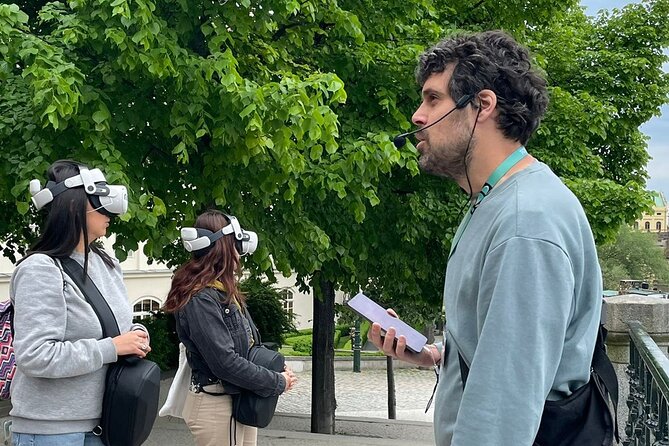
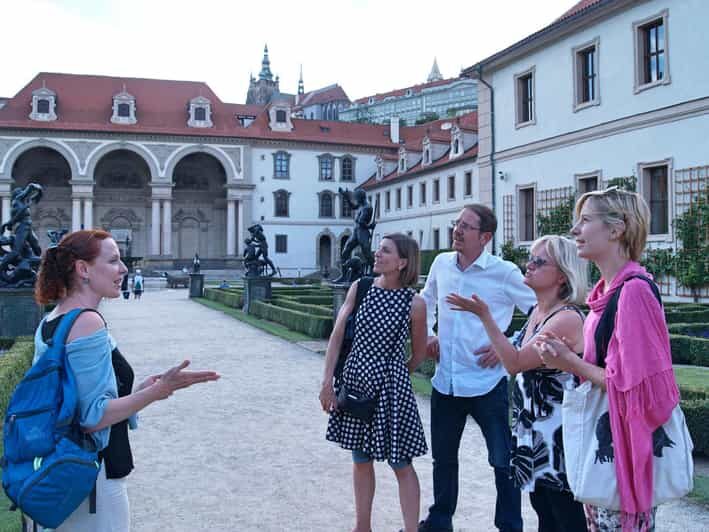
This is the kind of Prague tour that fixes a common problem: you can read plaques all day and still feel like the city’s story is chopped into disconnected facts. Here, the VR brings time periods to life right where you are, and each stop focuses on a specific chapter.
What makes it work is the matching. You’re not floating in space. You’re standing near places you’ll recognize—Old Town Square, the Charles Bridge area, Josefov, and the central squares—and the VR overlays give you a time-stamped view of what that area may have looked like back then. That trick helps your brain do something useful: connect today’s streets to yesterday’s streets.
The timing is also sensible. The tour runs about 1 hour 45 minutes, with roughly 20 minutes per stop, so you get a full story arc without feeling like you got trapped for half a day. It’s a smart way to get your bearings fast, especially if you’re planning to explore on your own afterward.
You can also read our reviews of more tours and experiences in Prague.


Stare Město in 1377: Charles IV’s Old Town Square
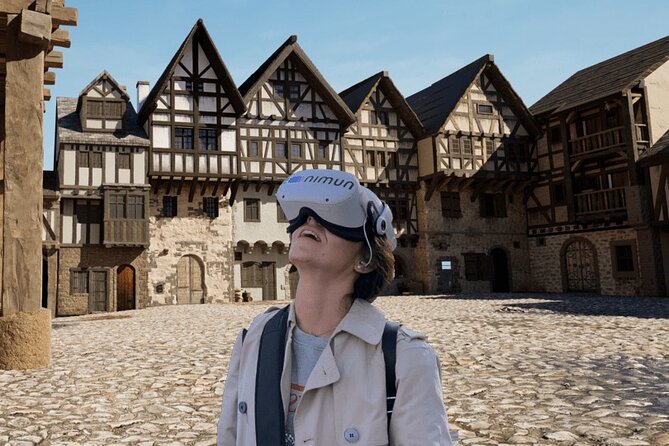
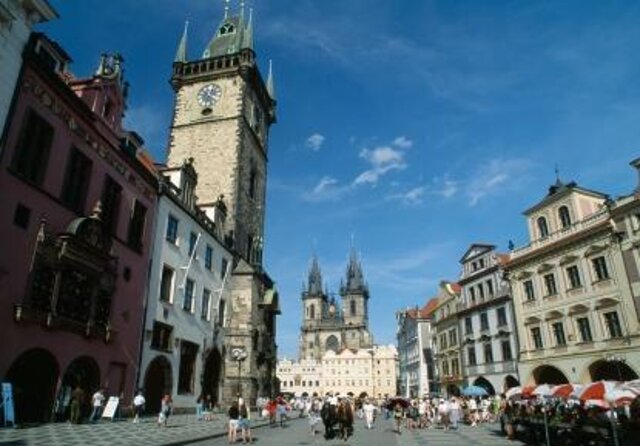
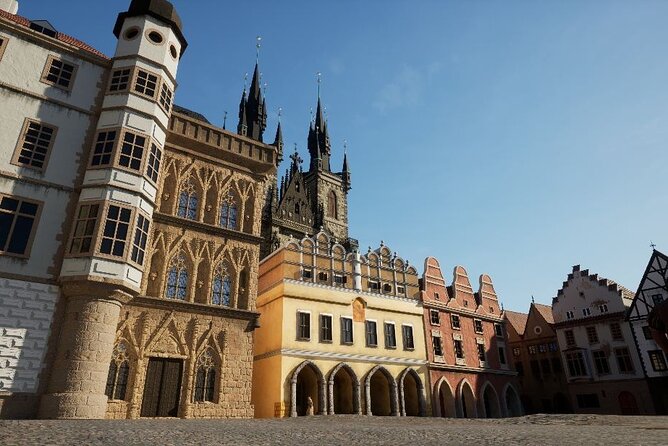
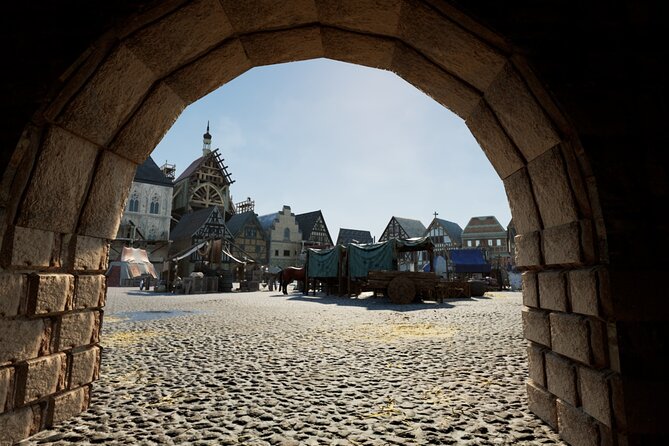
Your first jump is to medieval Prague in 1377, centered on Stare Město and a different version of Old Town Square. Standing in the same general area as the historic core, you get a sense of what the square might have been like under Charles IV, when Prague was shaping itself as a major power.
This stop matters because Old Town Square is the heart of so many Prague strolls. Today it’s easy to treat it as scenery. In 1377 mode, it becomes a stage: you’re seeing why this area mattered, and you can understand how a square can drive daily life, politics, and public events.
A small practical note: because VR sessions work best when you’re not rushing, arrive with a calm mindset. If you’re trying to squeeze the tour between other timed tickets, you may feel the pressure. But if you treat it as the storytelling starter for your day, it clicks.
Charles Bridge and the Vltava in 1342: Banks, Walls, and the Judith Bridge
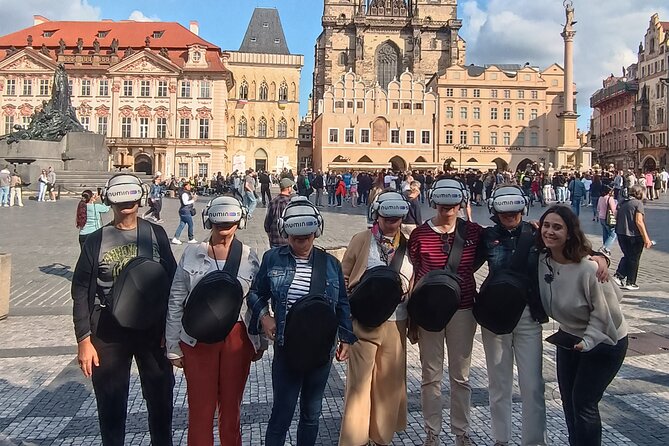
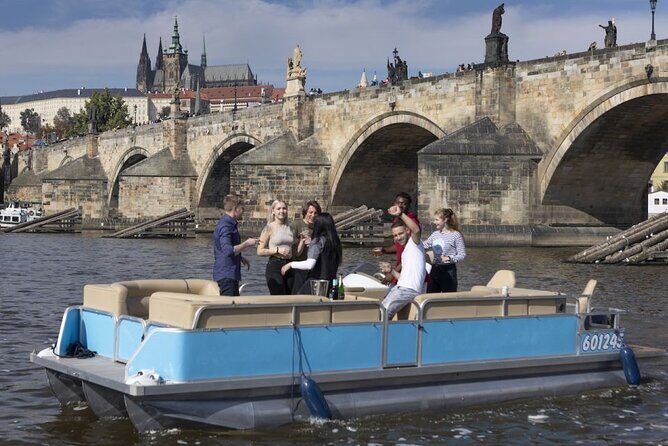
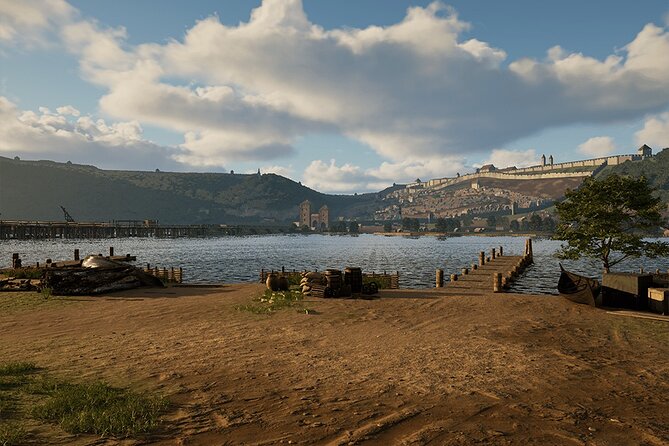
Next you move toward the Vltava River and the Charles Bridge area, traveling back to 1342. This part is about scale and positioning: you’re getting panoramic views of both banks and seeing how the riverfront connects districts across the water.
Two details make this stop especially memorable. First, the VR perspective includes the old Judith Bridge in its last moments. Second, it points you toward the sense of defense and identity in Malá Strana, including the walls that helped define how people moved and where power sat.
Why this helps you as a visitor: Charles Bridge today is a traffic jam of tourists and photos. VR gives you a reason to look beyond the crowd. You start thinking like a map reader—river to bridge, bridge to district, and how the city’s geography shaped its history.
Drawback to keep in mind: this stop is tied to how the city looks at street level and from viewpoints. If you’re expecting a fully seated, theater-style experience, you might be slightly disappointed. The tour is designed to connect VR with real walking space, not isolate you in one room the whole time.
Josefov in 1600: Seeing the Former Jewish Ghetto
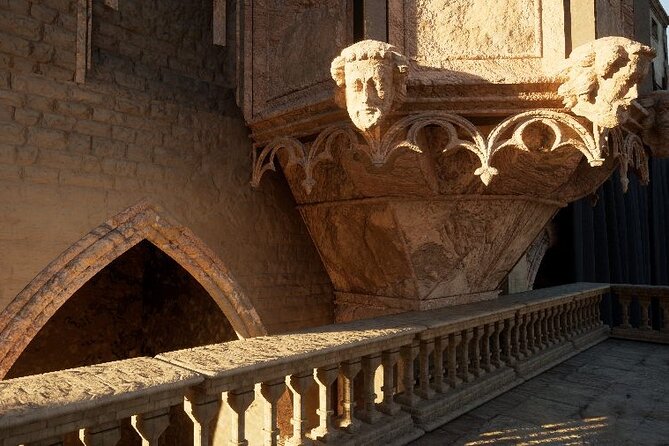
Then the route shifts into Josefov, with a jump to 1600 and the former Jewish ghetto. This is the stop that often feels the most emotionally grounding—not because it’s graphic in the details you’re given here, but because it centers a real community and a specific time.
Josefov is one of those Prague neighborhoods where modern visitors can feel like they’re looking at layers. VR helps you organize those layers. Instead of seeing synagogues and old streets as disconnected sights, you get a clearer time frame for how the area was shaped in that era.
This stop is also a good reminder that Prague’s story is more than rulers and battles. The city’s identity has always been shaped by the people living inside it, and a tour like this can help you notice that difference.
If you’re the type of traveler who likes cultural context as much as stone-and-view photos, you’ll likely rate this stop highly. If you’re mainly chasing dramatic panoramas, it may feel more reflective than flashy—but it still supports the overall storyline.
Staroměstské náměstí in 1621: A Turning-Point Moment
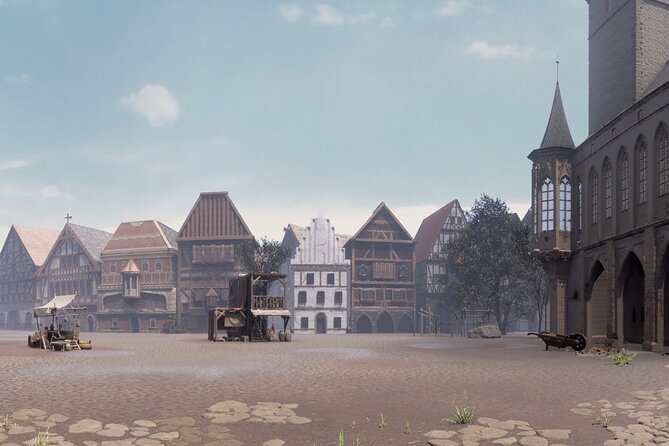
The final chapter takes you back to Staroměstské náměstí in 1621. This stop is framed around an event that would condition Prague’s history forever—one of those moments where the city doesn’t just change a little. It changes direction.
Even if you don’t come to Prague with deep prior knowledge, the VR time setting helps. You’re standing at a central stage, and the experience is designed to show how a single event can ripple through a city’s later years. It’s a history lesson that doesn’t feel like a lecture because it’s tied to place.
This ending works well if you’re also planning to keep exploring afterward. Once you’ve seen how the city can be transformed by a specific point in time, your next steps around Prague feel more intentional. You stop seeing sights as isolated stops and start seeing them as consequences.
One consideration: this last part is still part of a short 20-minute VR block. If you love to linger and read every plaque you see, you may want a bit of extra free time afterward to follow up with your own questions.




Guides Like Anna and Lara Make It Make Sense
The VR visuals do the heavy lifting, but the guide is what turns it into a real understanding. In past groups, names like Anna and Lara have come up, and that lines up with what you want from a guide in a time-travel experience: clear explanations, good pacing, and the ability to connect centuries without losing you.
You can expect the guide to keep you oriented across centuries—what you’re seeing, why the time period matters, and how each location fits into Prague’s larger story. That’s important because VR can sometimes feel like a sequence of cool scenes. Here, the narration helps you remember what matters.
I also like the human touch in the way groups are described by people who took it: the experience often feels like two guides working with you while you watch and move. If you want facts, you can get them. If you want the story delivered in plain, usable language, you get that too.
If you’re traveling with kids or multigenerational friends, look for guides who explain in an age-friendly way. The experience is built so that most people can participate, and the guide’s job is to keep everyone following.
Price and Timing: Getting Value From an 1h45 VR Story
At $18.15 per person, this is priced like a thoughtful add-on rather than a premium, all-day commitment. The value comes from time and structure: 1 hour 45 minutes is short enough to fit between other sightseeing plans, but long enough to deliver four distinct time periods.
Also, the max group size of 15 matters. VR tours can feel crowded or hectic if too many people pile in. A small group helps the pacing stay comfortable and makes it easier for the guide to manage questions and attention.
The tour starts at 3:00 pm, which is a smart time slot for many itineraries. It gives you the morning to wander, then uses the afternoon slot to add depth. Plus, ending back at the meeting point means you can keep your momentum without hunting for where you’ll finish.
And yes, you should factor in the weather requirement. If Prague is having a rough day, this kind of route might be adjusted. The good news: if it’s canceled due to poor weather, you’ll be offered another date or a full refund. That reduces the risk of booking on a day when conditions might be iffy.
Where You Start and How the Route Fits Your Day
You’ll meet at Numinos – Travel back in time with Immersive Tours, Celetná 558/12, 110 00 Praha 1-Staré Město. It ends back at the same meeting point, which is handy if you want to continue exploring Old Town afterward.
The tour is offered in English, uses a mobile ticket, and it’s near public transportation. Service animals are allowed, and most people can participate. Translation: this is built for normal tourists, not only for hardcore history buffs.
One tip that pays off: don’t schedule an ultra-tight connection afterward. Even if the tour runs about 1h45, you’ll want time to decompress, take a few real-world photos, and adjust your plan while the history is still fresh in your head.
Should You Book This Prague VR Time-Travel Tour?
Book it if you want Prague history with structure and without the heavy lifting of constant reading. The best case is a first-time visitor, or anyone who feels like they know the names of sights but not what they meant. The VR time jumps—1377, 1342, 1600, and 1621—help you build a mental timeline fast.
Skip it if you want a long, slow walking tour with lots of on-street exploring and deep stops for museum-level detail. This experience is short by design, and it trades extra roaming time for focused VR storytelling.
One last practical call: if weather is questionable, check conditions and keep some flexibility. Since the experience requires good weather, you’ll be happier if you treat it as a planned highlight rather than a fragile link in your schedule.
FAQ
How long is the Prague Immersive Tour?
It runs for about 1 hour 45 minutes.
What language is the tour offered in?
The tour is offered in English.
Where do I meet the tour?
You meet at Numinos – Travel back in time with Immersive Tours, Celetná 558/12, 110 00 Praha 1-Staré Město, Czechia.
Is there a mobile ticket?
Yes, a mobile ticket is provided.
How many people are in the group?
The tour has a maximum of 15 travelers.
Does the tour require good weather?
Yes, it requires good weather. If it’s canceled due to poor weather, you’ll be offered a different date or a full refund.
What is the cancellation policy?
You can cancel for a full refund up to 24 hours before the experience’s start time. If you cancel less than 24 hours before, the amount paid is not refunded.