Prague hits different when you walk it. This compact Old Town + Jewish Quarter route is built around famous landmarks, but you get the “how did this happen?” context that turns stone and symbols into something you can picture. I love that the tour is structured for moving on foot—so you get an instant sense of where everything sits—and I also love the stop at the Jewish Quarter, where the sights are deeply meaningful without feeling like you’re stuck in a museum.
One thing to consider: the full experience depends on your guide’s style and pace. If you’re sensitive to fast English, plan to concentrate when questions come up, and remember some moments are short because the route is designed to cover a lot.
In This Review
- Key points to know before you go
- Starting on Na Příkopě, then ending by Charles Bridge
- Wenceslas Square: the Czech story before the postcards
- Old Town (Stare Mesto): monuments you can actually connect
- Old Town Hall and the Astronomical Clock: learning to read the machinery
- Church of Our Lady before Týn, Jan Hus Monument, Theatre Des Etats, Powder Tower
- Prague Jewish Quarter: Old-New Synagogue and the Old Jewish Cemetery
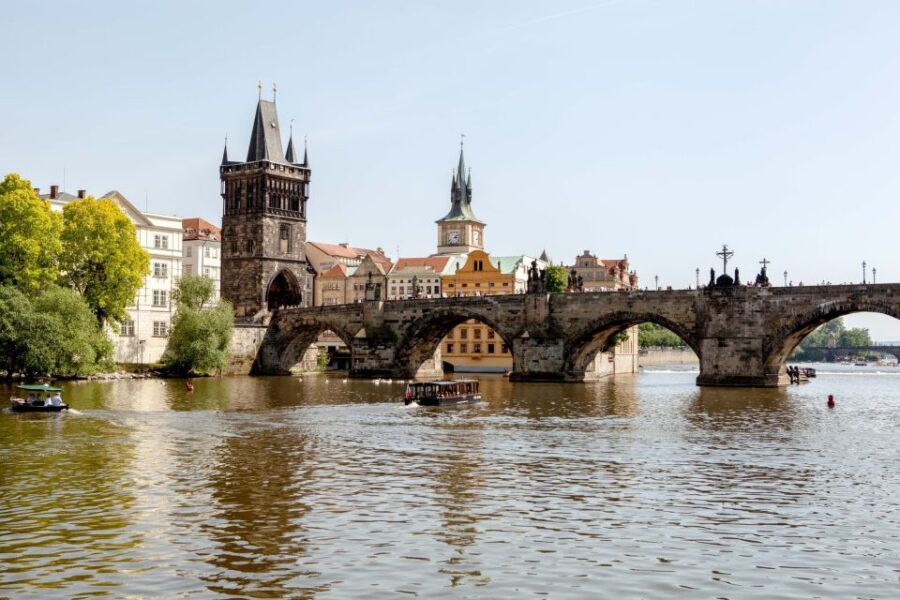
- Charles Bridge finale: statues, angle, and river views
- Price value: a low booking fee plus a tip-based guide
- How the guide shapes the day: pace, English, and crowd reality
- Who should book this Old Town plus Jewish Quarter walk?
- Should you book it?
- FAQ
- How long is the tour?
- How much does it cost?
- Are there any paid monuments included?
- Is the tour in English?
- What’s the meeting point and where does it end?
- Is it tip-based and do I need to pay admission?
Key points to know before you go
- A route that stacks major sights efficiently: Wenceslas Square to Old Town Hall to Charles Bridge, with the Jewish Quarter in the middle.
- Astronomical Clock time, explained: you’ll learn how to read it instead of just passing it.
- Old Town monuments without paid entries: the tour focuses on what’s free to see along the route.
- Jewish Quarter with real focus: the Old-New Synagogue plus the Old Jewish Cemetery are part of the walk.
- Charles Bridge ends the tour with a built-in photo moment on the river bank.
- Small group size (max 30) makes it easier to ask questions and keep moving.
Starting on Na Příkopě, then ending by Charles Bridge
You’ll meet at Prague Pulse Tours on Na Příkopě 13/394, in Staré Město. The finish is on the river bank at Alšovo nábř. 70/8, with a view of Charles Bridge. That ending matters more than it sounds. Instead of marching you back to a random corner, the tour sets you up for the next step of your trip: lingering by the water, grabbing a drink nearby, or continuing your walk over the bridge while the city is still “fresh” in your head.
The tour runs for about 2 hours 30 minutes, and you can choose a morning or afternoon departure. So you can match your energy level—some people prefer the earlier start before crowds thicken, others like the late light for photos. Either way, the walking route keeps you close to the big names: Old Town Hall, the Old Town Square area, the Jewish Quarter, and then the bridge.
Also, this is set up for real-world travel: it’s offered in English, it uses a mobile ticket, and it’s near public transportation. Service animals are allowed too, and the group stays small (up to 30), which helps with listening and crowd flow.
You can also read our reviews of more tours and experiences in Prague.


Wenceslas Square: the Czech story before the postcards
Your first stop is Wenceslas Square, a place that works like an open textbook. Here you’ll learn the foundations of Czech history and spend a few minutes admiring the square itself. Even if you’ve seen photos, this square hits in person because it’s a stage: wide space, strong lines, and a sense that major events happened here.
This is a smart warm-up stop. Instead of jumping straight into old buildings, the guide sets a baseline so what you see next in Old Town has context. It also helps you read the city as you walk. When you’re later staring at monuments, statues, and historic facades, you’ll know what kind of story you’re looking at—national pride, civic power, religious life, and the constant push-and-pull of history.
The square stop is short—about 7 minutes—but short doesn’t mean shallow. It’s meant to get your attention and give you a framework. If you’re the type who likes to ask questions, this is a good moment to do it, because you’re not yet dealing with the tight lanes of Old Town or the slower, more personal pace of the Jewish Quarter.
Old Town (Stare Mesto): monuments you can actually connect
Next comes Stare Mesto (Old Town), described as the part of Prague with one of the highest concentration of monuments. You’ll admire the area and hear the stories behind what you’re seeing. This is where the tour becomes more than a checklist. Old Town Square and its surroundings can feel like a photo trap if you show up cold. With the guide’s framing, you start noticing the “why” of the buildings—who they served, what they symbolized, and how Prague’s identity got written into stone.
A big win here is that the tour keeps moving while still giving you a chance to pause at key points. That balance matters. You don’t want an overly slow tour that turns into a queue simulator, and you also don’t want a rush-through where you forget what you just saw ten minutes later. The route finds a middle path.
If you’re planning your own day after the walk, this part helps you understand the layout: where Old Town Hall sits, how the square area connects to nearby churches and civic landmarks, and how all of it lines up toward the bridge.
Old Town Hall and the Astronomical Clock: learning to read the machinery
At Old Town Hall, you’ll stop for the Astronomical Clock. This is one of the most famous things in Prague, and it’s also one of the easiest to misunderstand. A quick glance tells you it’s dramatic. This stop is different because you’ll learn how to read the clock—so you can understand what you’re seeing rather than just admiring the surface.
Even in the short 15-minute window, the goal is clear: make the clock make sense. You’ll get the pieces explained and how they connect. That turns your future viewing into something active. Later, when you return on your own, you’re not standing there thinking, I’ve got no idea what that’s doing. You’ll have a mental map of how the mechanism tells time and tells story.
One practical thing: since this is a top attraction, the area can get busy. Give yourself permission to focus first on understanding, then on photos. If you’re trying to do both, it can help to take one solid photo early and then spend the rest of the stop listening.
Church of Our Lady before Týn, Jan Hus Monument, Theatre Des Etats, Powder Tower
After the clock, the route fans out through several shorter stops that still pack meaning:
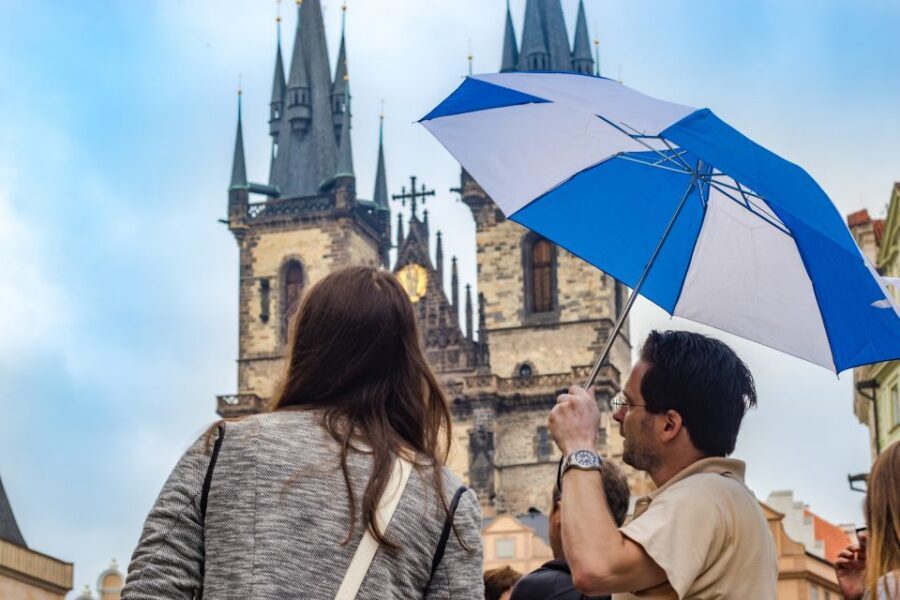
- Church of Our Lady before Týn (about 10 minutes): you’ll learn why it took over a century to be built. That’s the kind of detail that makes the building feel less like scenery and more like a long project with real stakes.
- Jan Hus Monument (about 10 minutes): you’ll learn about this Czech national hero, and how the monument’s size and placement connect to Old Town Square’s identity.
- Theatre Des Etats (about 5 minutes): the tour connects the theatre to Mozart’s time in Prague. Even if you’re not a classical-music superfan, it’s a fun doorway into the city’s artistic life.
- The Powder Tower (about 5 minutes): you’ll see the very last gateway to the old town. This is a quick but memorable shift—from civic and religious landmarks into the feel of a city boundary and its defensive history.
These are “stop and reset” moments. Each one is brief, so it’s good for your stamina but also requires a bit of attention. If you’re hoping for long, slow explanations at each site, this isn’t that kind of tour. But if you want the most important Old Town landmarks tied into one coherent story, this set of stops works well.
Also, the proximity between these sights is a big part of the value. You’re not spending your time crossing Prague by transit. You’re doing it the way the city wants you to do it: step-by-step, with the guide pointing out what’s easy to miss when you’re moving solo.
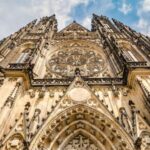
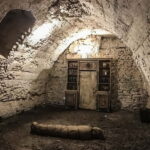

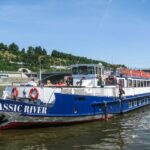
Prague Jewish Quarter: Old-New Synagogue and the Old Jewish Cemetery
Then the tour turns into something deeper and more personal: the Prague Jewish Quarter. You’ll spend about 30 minutes here, and the tone shifts to reflect the significance of the area.
You’ll see and hear about:
- The Old-New Synagogue (about 10 minutes): described as the oldest still practicing synagogue in Europe. This is the kind of line that matters. It’s not just history behind glass; it’s an active cultural and religious thread.
- The Old Jewish Cemetery (about 10 minutes): you’ll learn about the cemetery and the life of people in this area.
This is one of the most valuable parts of the whole experience because it keeps the day from becoming purely aesthetic. Prague’s central areas can sometimes blur into “pretty buildings.” Here, the tour asks you to look at what community and memory look like over time.
A practical note: because the Jewish Quarter section is emotionally heavier and more reflective, you’ll likely want to put your phone away for a minute or two and just listen. Photos are great, but these stops work better when you treat them like a human story, not just a sightseeing highlight.
Charles Bridge finale: statues, angle, and river views
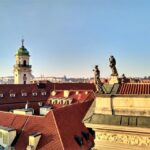
The last stop is Charles Bridge, with about 10 minutes dedicated to seeing it and learning about its iconic statues. Then the tour ends on the river bank at Alšovo nábř., where you get the view that ties the day together.
Finishing by the water is smart for two reasons. First, it gives you a natural place to stop walking and catch your breath. Second, it makes the day feel complete. After Old Town, synagogues, and cemetery history, Charles Bridge becomes more than a famous bridge—it turns into the physical link between parts of Prague you’ve been talking about for hours.
What to do with your last minutes: pick one statue area you want to focus on, take one good photo, and then look at the bridge from the riverbank angle if you can. Even a short listen to the guide’s explanation can make you notice details you’d normally skip.
Price value: a low booking fee plus a tip-based guide
The listed price is $3.63 per person for a 2.5-hour walking tour with a licensed local guide and a mobile ticket. The tour is tip-based, meaning your payment is largely an admin reservation fee rather than a full guide salary.
For value, this model can be great—if you show up ready to participate. You’re not paying for a museum ticket or paid entrances, and the tour doesn’t include entry fees for paid monuments. So you’re getting the guide experience and the walking route where you need it.
The best mindset: treat it as a guided orientation plus storytelling. If the guide does a good job for you—answering questions, sharing context, and keeping the group moving—you’ll know why tipping is expected. If you don’t feel it landed for you, you’ll still have had a guided path through major landmarks and a jump-start on your next day’s planning.
One caution: you should expect that guide personalities can differ. Some guides are quick and energetic, and if your English comfort is limited, you might want to concentrate more on the key points. If you end up with a faster speaker, try not to panic—take notes on a phone and save your questions for the less crowded moments.
How the guide shapes the day: pace, English, and crowd reality
This kind of tour lives or dies on guide delivery. The general vibe here is that guides are engaged and willing to answer questions and recommend other stops. People have highlighted guides like Mel, Aris, Zach, and Dylan for turning landmarks into living context—and for giving practical advice on where to eat and what else to do.
Still, there are a few realities to plan for:
- English pace can be fast. If English isn’t your first language, listen closely when the guide is explaining something important, especially around the Astronomical Clock and Jewish Quarter.
- Time is tight at each stop. The route is designed to hit many sights. That means you might get less room for lingering at the edge of the crowd than you’d like.
- Crowds can change the flow. Big places like Charles Bridge and central Old Town are busy, and if there’s a local event happening, moving as a group can be slower than usual.
The good news: with a max group size of 30, the guide has room to keep everyone together and handle questions without losing the thread. The tour also encourages you to ask for recommendations during the walk, which is where it becomes more useful than a standard “see-and-go” loop.
Who should book this Old Town plus Jewish Quarter walk?
Book this tour if you want a structured walking overview with enough context to make Prague feel coherent. It’s a strong fit for:
- First-time visitors who want to learn the city’s layout fast
- Travelers who enjoy history but don’t want to spend the day inside paid attractions
- People who like photo stops but also want the story behind them
- Adults and older teens who can handle a steady walking pace over 2½ hours
It might not be the best match if you’re looking for long stops inside major attractions, or if you need extremely slow pacing and lots of time at one site. This tour trades time for coverage, which is exactly why it works so well for an efficient day.
Should you book it?
Yes—if you approach it as a guided orientation plus key-sight storytelling. The price is low, the route hits the big names that define central Prague, and the guide experience is what you’re really buying. The standout value for me is the mix: Old Town landmarks and the Jewish Quarter stops with the Old-New Synagogue and the Old Jewish Cemetery—plus a satisfying finish on the Charles Bridge riverbank.
Just go in with the right expectations. You’ll cover a lot, you’ll learn how to read major sights like the Astronomical Clock, and you’ll leave with a clearer sense of where to go next. If you’re the type who asks questions and pays attention while walking, you’ll get your money’s worth—then some.
FAQ
How long is the tour?
The tour is about 2 hours 30 minutes.
How much does it cost?
The price listed is $3.63 per person.
Are there any paid monuments included?
No paid monuments are entered. No admission fees are needed.
Is the tour in English?
Yes, the tour is offered in English.
What’s the meeting point and where does it end?
You meet at Prague Pulse Tours, Na Příkopě 13/394 in Staré Město. The tour ends at Alšovo nábř. 70/8 on the river bank with a view of Charles Bridge.
Is it tip-based and do I need to pay admission?
The tour is tip-based, and the small reservation payment is for admin purposes. Admission to paid monuments isn’t included because the tour does not enter them.